

CSA and UL
-
261-ST-12
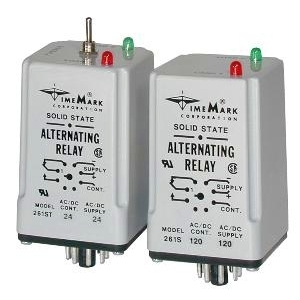
The Model 261 series Alternating Relay is designed for duplex pumping systems where it is desirable to equalize pump run time. The solid-state alternating circuit drives an internal electromechanical relay. A continuous power source and control switch are required. The control switch (float, pressure or other isolated contact) is connected between the L1 terminal and the control terminal. Each time the control switch is opened the output contacts will change states. Indicator lights on the case show the internal relay status. On the optional toggle switch versions, the toggle switch is set to the ALTERNATE position. Setting the switch to Load 1 or Load 2 will lock the relay in position, preventing alternation. -
261-S-12
The Model 261 series Alternating Relay is designed for duplex pumping systems where it is desirable to equalize pump run time. The solid-state alternating circuit drives an internal electromechanical relay. A continuous power source and control switch are required. The control switch (float, pressure or other isolated contact) is connected between the L1 terminal and the control terminal. Each time the control switch is opened the output contacts will change states. Indicator lights on the case show the internal relay status. On the optional toggle switch versions, the toggle switch is set to the ALTERNATE position. Setting the switch to Load 1 or Load 2 will lock the relay in position, preventing alternation. -
261-DXT-12
The Model 261 series Alternating Relay is designed for duplex pumping systems where it is desirable to equalize pump run time. The solid-state alternating circuit drives an internal electromechanical relay. A continuous power source and control switch are required. The control switch (float, pressure or other isolated contact) is connected between the L1 terminal and the control terminal. Each time the control switch is opened the output contacts will change states. Indicator lights on the case show the internal relay status. On the optional toggle switch versions, the toggle switch is set to the ALTERNATE position. Setting the switch to Load 1 or Load 2 will lock the relay in position, preventing alternation. -
261-DX-12
The Model 261 series Alternating Relay is designed for duplex pumping systems where it is desirable to equalize pump run time. The solid-state alternating circuit drives an internal electromechanical relay. A continuous power source and control switch are required. The control switch (float, pressure or other isolated contact) is connected between the L1 terminal and the control terminal. Each time the control switch is opened the output contacts will change states. Indicator lights on the case show the internal relay status. On the optional toggle switch versions, the toggle switch is set to the ALTERNATE position. Setting the switch to Load 1 or Load 2 will lock the relay in position, preventing alternation. -
261-DT-12
The Model 261 series Alternating Relay is designed for duplex pumping systems where it is desirable to equalize pump run time. The solid-state alternating circuit drives an internal electromechanical relay. A continuous power source and control switch are required. The control switch (float, pressure or other isolated contact) is connected between the L1 terminal and the control terminal. Each time the control switch is opened the output contacts will change states. Indicator lights on the case show the internal relay status. On the optional toggle switch versions, the toggle switch is set to the ALTERNATE position. Setting the switch to Load 1 or Load 2 will lock the relay in position, preventing alternation. -
261-D-12
The Model 261 series Alternating Relay is designed for duplex pumping systems where it is desirable to equalize pump run time. The solid-state alternating circuit drives an internal electromechanical relay. A continuous power source and control switch are required. The control switch (float, pressure or other isolated contact) is connected between the L1 terminal and the control terminal. Each time the control switch is opened the output contacts will change states. Indicator lights on the case show the internal relay status. On the optional toggle switch versions, the toggle switch is set to the ALTERNATE position. Setting the switch to Load 1 or Load 2 will lock the relay in position, preventing alternation. -
DC260BM-90-150
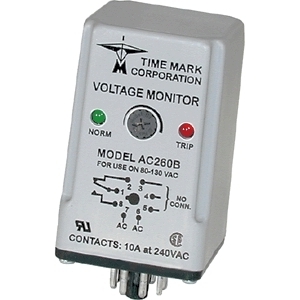
The Model 260 Voltage Sensor is a single set-point voltage sensor. Input voltages above the set-point cause the output contacts to energize (contacts 1 & 8 closed). Input voltages below the set-point cause the output contacts to de-energize (contacts 1 & 2 closed). The dead band between pull-in and drop-out is less than 2%.The standard unit has a screwdriver, or fingertip adjustable set-point range of approximately 35%. of the maximum voltage. This device can also be provided with a factory calibrated trip point.
AC versions of the Model 260 Voltage Sensor are not frequency sensitive, and may be used in systems from 50 Hz to 400 Hz. DC models are not polarity sensitive. This device requires a standard 8-pin socket, such as Time Mark’s Model 51×120.
-
DC260BM-60-92
The Model 260 Voltage Sensor is a single set-point voltage sensor. Input voltages above the set-point cause the output contacts to energize (contacts 1 & 8 closed). Input voltages below the set-point cause the output contacts to de-energize (contacts 1 & 2 closed). The dead band between pull-in and drop-out is less than 2%.The standard unit has a screwdriver, or fingertip adjustable set-point range of approximately 35%. of the maximum voltage. This device can also be provided with a factory calibrated trip point.
AC versions of the Model 260 Voltage Sensor are not frequency sensitive, and may be used in systems from 50 Hz to 400 Hz. DC models are not polarity sensitive. This device requires a standard 8-pin socket, such as Time Mark’s Model 51×120.
-
DC260BM-42-64
The Model 260 Voltage Sensor is a single set-point voltage sensor. Input voltages above the set-point cause the output contacts to energize (contacts 1 & 8 closed). Input voltages below the set-point cause the output contacts to de-energize (contacts 1 & 2 closed). The dead band between pull-in and drop-out is less than 2%.The standard unit has a screwdriver, or fingertip adjustable set-point range of approximately 35%. of the maximum voltage. This device can also be provided with a factory calibrated trip point.
AC versions of the Model 260 Voltage Sensor are not frequency sensitive, and may be used in systems from 50 Hz to 400 Hz. DC models are not polarity sensitive. This device requires a standard 8-pin socket, such as Time Mark’s Model 51×120.
-
DC260BM-30-46
The Model 260 Voltage Sensor is a single set-point voltage sensor. Input voltages above the set-point cause the output contacts to energize (contacts 1 & 8 closed). Input voltages below the set-point cause the output contacts to de-energize (contacts 1 & 2 closed). The dead band between pull-in and drop-out is less than 2%.The standard unit has a screwdriver, or fingertip adjustable set-point range of approximately 35%. of the maximum voltage. This device can also be provided with a factory calibrated trip point.
AC versions of the Model 260 Voltage Sensor are not frequency sensitive, and may be used in systems from 50 Hz to 400 Hz. DC models are not polarity sensitive. This device requires a standard 8-pin socket, such as Time Mark’s Model 51×120.
-
DC260BM-20-24
The Model 260 Voltage Sensor is a single set-point voltage sensor. Input voltages above the set-point cause the output contacts to energize (contacts 1 & 8 closed). Input voltages below the set-point cause the output contacts to de-energize (contacts 1 & 2 closed). The dead band between pull-in and drop-out is less than 2%.The standard unit has a screwdriver, or fingertip adjustable set-point range of approximately 35%. of the maximum voltage. This device can also be provided with a factory calibrated trip point.
AC versions of the Model 260 Voltage Sensor are not frequency sensitive, and may be used in systems from 50 Hz to 400 Hz. DC models are not polarity sensitive. This device requires a standard 8-pin socket, such as Time Mark’s Model 51×120.
-
DC260BM-160-250
The Model 260 Voltage Sensor is a single set-point voltage sensor. Input voltages above the set-point cause the output contacts to energize (contacts 1 & 8 closed). Input voltages below the set-point cause the output contacts to de-energize (contacts 1 & 2 closed). The dead band between pull-in and drop-out is less than 2%.The standard unit has a screwdriver, or fingertip adjustable set-point range of approximately 35%. of the maximum voltage. This device can also be provided with a factory calibrated trip point.
AC versions of the Model 260 Voltage Sensor are not frequency sensitive, and may be used in systems from 50 Hz to 400 Hz. DC models are not polarity sensitive. This device requires a standard 8-pin socket, such as Time Mark’s Model 51×120.
-
DC260B-90-150
The Model 260 Voltage Sensor is a single set-point voltage sensor. Input voltages above the set-point cause the output contacts to energize (contacts 1 & 8 closed). Input voltages below the set-point cause the output contacts to de-energize (contacts 1 & 2 closed). The dead band between pull-in and drop-out is less than 2%.The standard unit has a screwdriver, or fingertip adjustable set-point range of approximately 35%. of the maximum voltage. This device can also be provided with a factory calibrated trip point.
AC versions of the Model 260 Voltage Sensor are not frequency sensitive, and may be used in systems from 50 Hz to 400 Hz. DC models are not polarity sensitive. This device requires a standard 8-pin socket, such as Time Mark’s Model 51×120.
-
DC260B-60-92
The Model 260 Voltage Sensor is a single set-point voltage sensor. Input voltages above the set-point cause the output contacts to energize (contacts 1 & 8 closed). Input voltages below the set-point cause the output contacts to de-energize (contacts 1 & 2 closed). The dead band between pull-in and drop-out is less than 2%.The standard unit has a screwdriver, or fingertip adjustable set-point range of approximately 35%. of the maximum voltage. This device can also be provided with a factory calibrated trip point.
AC versions of the Model 260 Voltage Sensor are not frequency sensitive, and may be used in systems from 50 Hz to 400 Hz. DC models are not polarity sensitive. This device requires a standard 8-pin socket, such as Time Mark’s Model 51×120.
-
DC260B-42-64
The Model 260 Voltage Sensor is a single set-point voltage sensor. Input voltages above the set-point cause the output contacts to energize (contacts 1 & 8 closed). Input voltages below the set-point cause the output contacts to de-energize (contacts 1 & 2 closed). The dead band between pull-in and drop-out is less than 2%.The standard unit has a screwdriver, or fingertip adjustable set-point range of approximately 35%. of the maximum voltage. This device can also be provided with a factory calibrated trip point.
AC versions of the Model 260 Voltage Sensor are not frequency sensitive, and may be used in systems from 50 Hz to 400 Hz. DC models are not polarity sensitive. This device requires a standard 8-pin socket, such as Time Mark’s Model 51×120.
-
DC260B-30-46
The Model 260 Voltage Sensor is a single set-point voltage sensor. Input voltages above the set-point cause the output contacts to energize (contacts 1 & 8 closed). Input voltages below the set-point cause the output contacts to de-energize (contacts 1 & 2 closed). The dead band between pull-in and drop-out is less than 2%.The standard unit has a screwdriver, or fingertip adjustable set-point range of approximately 35%. of the maximum voltage. This device can also be provided with a factory calibrated trip point.
AC versions of the Model 260 Voltage Sensor are not frequency sensitive, and may be used in systems from 50 Hz to 400 Hz. DC models are not polarity sensitive. This device requires a standard 8-pin socket, such as Time Mark’s Model 51×120.