
Engineered and Built in the USA
(800) 862-2875

Voltage & Frequency Monitors
Showing 17–32 of 68 resultsSorted by latest
-
AC260BM-160-250
The Model 260 Voltage Sensor is a single set-point voltage sensor. Input voltages above the set-point cause the output contacts to energize (contacts 1 & 8 closed). Input voltages below the set-point cause the output contacts to de-energize (contacts 1 & 2 closed). The dead band between pull-in and drop-out is less than 2%.The standard unit has a screwdriver, or fingertip adjustable set-point range of approximately 35%. of the maximum voltage. This device can also be provided with a factory calibrated trip point.
AC versions of the Model 260 Voltage Sensor are not frequency sensitive, and may be used in systems from 50 Hz to 400 Hz. DC models are not polarity sensitive. This device requires a standard 8-pin socket, such as Time Mark’s Model 51×120.
-
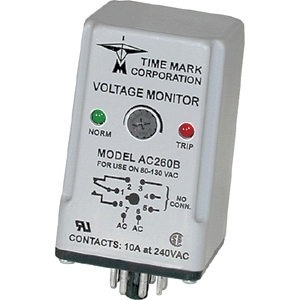
AC260B-80-130
The Model 260 Voltage Sensor is a single set-point voltage sensor. Input voltages above the set-point cause the output contacts to energize (contacts 1 & 8 closed). Input voltages below the set-point cause the output contacts to de-energize (contacts 1 & 2 closed). The dead band between pull-in and drop-out is less than 2%.The standard unit has a screwdriver, or fingertip adjustable set-point range of approximately 35%. of the maximum voltage. This device can also be provided with a factory calibrated trip point.
AC versions of the Model 260 Voltage Sensor are not frequency sensitive, and may be used in systems from 50 Hz to 400 Hz. DC models are not polarity sensitive. This device requires a standard 8-pin socket, such as Time Mark’s Model 51×120.
-
AC260B-380-480
The Model 260 Voltage Sensor is a single set-point voltage sensor. Input voltages above the set-point cause the output contacts to energize (contacts 1 & 8 closed). Input voltages below the set-point cause the output contacts to de-energize (contacts 1 & 2 closed). The dead band between pull-in and drop-out is less than 2%.The standard unit has a screwdriver, or fingertip adjustable set-point range of approximately 35%. of the maximum voltage. This device can also be provided with a factory calibrated trip point.
AC versions of the Model 260 Voltage Sensor are not frequency sensitive, and may be used in systems from 50 Hz to 400 Hz. DC models are not polarity sensitive. This device requires a standard 8-pin socket, such as Time Mark’s Model 51×120.
-
AC260B-215-290
The Model 260 Voltage Sensor is a single set-point voltage sensor. Input voltages above the set-point cause the output contacts to energize (contacts 1 & 8 closed). Input voltages below the set-point cause the output contacts to de-energize (contacts 1 & 2 closed). The dead band between pull-in and drop-out is less than 2%.The standard unit has a screwdriver, or fingertip adjustable set-point range of approximately 35%. of the maximum voltage. This device can also be provided with a factory calibrated trip point.
AC versions of the Model 260 Voltage Sensor are not frequency sensitive, and may be used in systems from 50 Hz to 400 Hz. DC models are not polarity sensitive. This device requires a standard 8-pin socket, such as Time Mark’s Model 51×120.
-
AC260B-160-250
The Model 260 Voltage Sensor is a single set-point voltage sensor. Input voltages above the set-point cause the output contacts to energize (contacts 1 & 8 closed). Input voltages below the set-point cause the output contacts to de-energize (contacts 1 & 2 closed). The dead band between pull-in and drop-out is less than 2%.The standard unit has a screwdriver, or fingertip adjustable set-point range of approximately 35%. of the maximum voltage. This device can also be provided with a factory calibrated trip point.
AC versions of the Model 260 Voltage Sensor are not frequency sensitive, and may be used in systems from 50 Hz to 400 Hz. DC models are not polarity sensitive. This device requires a standard 8-pin socket, such as Time Mark’s Model 51×120.
-

2681-48VDC
The Model 2681 Voltage Band Monitor is a dual set-point voltage monitor. Input voltages between the upper and lower set-points will cause the output contacts to pull in (contacts 1 & 3 closed) and the LED indicator to illuminate. Input voltages above or below the set-points will cause the output contacts to drop out (contacts 1 & 4 closed) and extinguish the LED indicator.The Model 2681 is available in AC or DC versions. AC models of the 2681 are not frequency sensitive and can be used on systems from 50 to 400 Hz. The voltage set-points are screwdriver adjustable over a wide operating range.
The SPDT output configuration is identical to the configuration of general purpose relays. This unit requires a standard 8-pin socket for mounting.
-
2681-28VDC
The Model 2681 Voltage Band Monitor is a dual set-point voltage monitor. Input voltages between the upper and lower set-points will cause the output contacts to pull in (contacts 1 & 3 closed) and the LED indicator to illuminate. Input voltages above or below the set-points will cause the output contacts to drop out (contacts 1 & 4 closed) and extinguish the LED indicator.The Model 2681 is available in AC or DC versions. AC models of the 2681 are not frequency sensitive and can be used on systems from 50 to 400 Hz. The voltage set-points are screwdriver adjustable over a wide operating range.
The SPDT output configuration is identical to the configuration of general purpose relays. This unit requires a standard 8-pin socket for mounting.
-
2681-24VDC
The Model 2681 Voltage Band Monitor is a dual set-point voltage monitor. Input voltages between the upper and lower set-points will cause the output contacts to pull in (contacts 1 & 3 closed) and the LED indicator to illuminate. Input voltages above or below the set-points will cause the output contacts to drop out (contacts 1 & 4 closed) and extinguish the LED indicator.The Model 2681 is available in AC or DC versions. AC models of the 2681 are not frequency sensitive and can be used on systems from 50 to 400 Hz. The voltage set-points are screwdriver adjustable over a wide operating range.
The SPDT output configuration is identical to the configuration of general purpose relays. This unit requires a standard 8-pin socket for mounting.
-
2681-24VAC
The Model 2681 Voltage Band Monitor is a dual set-point voltage monitor. Input voltages between the upper and lower set-points will cause the output contacts to pull in (contacts 1 & 3 closed) and the LED indicator to illuminate. Input voltages above or below the set-points will cause the output contacts to drop out (contacts 1 & 4 closed) and extinguish the LED indicator.The Model 2681 is available in AC or DC versions. AC models of the 2681 are not frequency sensitive and can be used on systems from 50 to 400 Hz. The voltage set-points are screwdriver adjustable over a wide operating range.
The SPDT output configuration is identical to the configuration of general purpose relays. This unit requires a standard 8-pin socket for mounting.
-
2681-240VAC
The Model 2681 Voltage Band Monitor is a dual set-point voltage monitor. Input voltages between the upper and lower set-points will cause the output contacts to pull in (contacts 1 & 3 closed) and the LED indicator to illuminate. Input voltages above or below the set-points will cause the output contacts to drop out (contacts 1 & 4 closed) and extinguish the LED indicator.The Model 2681 is available in AC or DC versions. AC models of the 2681 are not frequency sensitive and can be used on systems from 50 to 400 Hz. The voltage set-points are screwdriver adjustable over a wide operating range.
The SPDT output configuration is identical to the configuration of general purpose relays. This unit requires a standard 8-pin socket for mounting.
-
2681-230VDC
The Model 2681 Voltage Band Monitor is a dual set-point voltage monitor. Input voltages between the upper and lower set-points will cause the output contacts to pull in (contacts 1 & 3 closed) and the LED indicator to illuminate. Input voltages above or below the set-points will cause the output contacts to drop out (contacts 1 & 4 closed) and extinguish the LED indicator.The Model 2681 is available in AC or DC versions. AC models of the 2681 are not frequency sensitive and can be used on systems from 50 to 400 Hz. The voltage set-points are screwdriver adjustable over a wide operating range.
The SPDT output configuration is identical to the configuration of general purpose relays. This unit requires a standard 8-pin socket for mounting.
-
2681-208VAC
The Model 2681 Voltage Band Monitor is a dual set-point voltage monitor. Input voltages between the upper and lower set-points will cause the output contacts to pull in (contacts 1 & 3 closed) and the LED indicator to illuminate. Input voltages above or below the set-points will cause the output contacts to drop out (contacts 1 & 4 closed) and extinguish the LED indicator.The Model 2681 is available in AC or DC versions. AC models of the 2681 are not frequency sensitive and can be used on systems from 50 to 400 Hz. The voltage set-points are screwdriver adjustable over a wide operating range.
The SPDT output configuration is identical to the configuration of general purpose relays. This unit requires a standard 8-pin socket for mounting.
-
2681-12VDC
The Model 2681 Voltage Band Monitor is a dual set-point voltage monitor. Input voltages between the upper and lower set-points will cause the output contacts to pull in (contacts 1 & 3 closed) and the LED indicator to illuminate. Input voltages above or below the set-points will cause the output contacts to drop out (contacts 1 & 4 closed) and extinguish the LED indicator.The Model 2681 is available in AC or DC versions. AC models of the 2681 are not frequency sensitive and can be used on systems from 50 to 400 Hz. The voltage set-points are screwdriver adjustable over a wide operating range.
The SPDT output configuration is identical to the configuration of general purpose relays. This unit requires a standard 8-pin socket for mounting.
-
2681-120VAC
The Model 2681 Voltage Band Monitor is a dual set-point voltage monitor. Input voltages between the upper and lower set-points will cause the output contacts to pull in (contacts 1 & 3 closed) and the LED indicator to illuminate. Input voltages above or below the set-points will cause the output contacts to drop out (contacts 1 & 4 closed) and extinguish the LED indicator.The Model 2681 is available in AC or DC versions. AC models of the 2681 are not frequency sensitive and can be used on systems from 50 to 400 Hz. The voltage set-points are screwdriver adjustable over a wide operating range.
The SPDT output configuration is identical to the configuration of general purpose relays. This unit requires a standard 8-pin socket for mounting.
-
2681-110VDC
The Model 2681 Voltage Band Monitor is a dual set-point voltage monitor. Input voltages between the upper and lower set-points will cause the output contacts to pull in (contacts 1 & 3 closed) and the LED indicator to illuminate. Input voltages above or below the set-points will cause the output contacts to drop out (contacts 1 & 4 closed) and extinguish the LED indicator.The Model 2681 is available in AC or DC versions. AC models of the 2681 are not frequency sensitive and can be used on systems from 50 to 400 Hz. The voltage set-points are screwdriver adjustable over a wide operating range.
The SPDT output configuration is identical to the configuration of general purpose relays. This unit requires a standard 8-pin socket for mounting.
-

2629
The Model 2629 AC/DC Voltage Monitor is designed to continuously monitor any AC or DC voltage from 15 to 260 volts.Input voltages below the set-point cause the output contacts to de-energize. Input voltages above the set-point cause the output contacts to energize. The dead band between pull-in and drop-out is less than 5%.
Dip switches are used on the Model 2629 to choose between AC and DC voltage monitoring, and to select one of the eight trip level ranges. Each trip level has a 35 voltage range, with a 5 volt overlap between the ranges. The unit has a screwdriver adjustment to set the exact trip point within that 35 volt range.