

Alternating Relay
Showing all 7 results
-

261XBXP-120
Alternating RelayRead moreThe Model 261XBXP(R) Alternating Relay uses the same solid-state latching and control circuit as all the other 261 series models, the enclosure and the connecting base being the major differences. This version was designed to replace a long time and widely used mechanical latching relay offered by another manufacturer. The modern circuitry used the Model 261XBXP offers a vast improvement in reliability and useful life over the mechanical type. The XBXP version of the relay requires closing the control switch to begin alternation, and the XBXPR version requires opening the control switch to begin alternation. Replacement of the original mechanical alternator with the Model 261XBXP requires the addition of wire from L1 to Pin 5 of the connector in order to supply continuous power to the solid-state circuit. Available in two voltage versions for use with 24 VAC/DC or 120 VAC/DC. -
261XBXP-24
Alternating RelayRead moreThe Model 261XBXP(R) Alternating Relay uses the same solid-state latching and control circuit as all the other 261 series models, the enclosure and the connecting base being the major differences. This version was designed to replace a long time and widely used mechanical latching relay offered by another manufacturer. The modern circuitry used the Model 261XBXP offers a vast improvement in reliability and useful life over the mechanical type. The XBXP version of the relay requires closing the control switch to begin alternation, and the XBXPR version requires opening the control switch to begin alternation. Replacement of the original mechanical alternator with the Model 261XBXP requires the addition of wire from L1 to Pin 5 of the connector in order to supply continuous power to the solid-state circuit. Available in two voltage versions for use with 24 VAC/DC or 120 VAC/DC. -
261XBXPR-120
Alternating RelayRead moreThe Model 261XBXP(R) Alternating Relay uses the same solid-state latching and control circuit as all the other 261 series models, the enclosure and the connecting base being the major differences. This version was designed to replace a long time and widely used mechanical latching relay offered by another manufacturer. The modern circuitry used the Model 261XBXP offers a vast improvement in reliability and useful life over the mechanical type. The XBXP version of the relay requires closing the control switch to begin alternation, and the XBXPR version requires opening the control switch to begin alternation. Replacement of the original mechanical alternator with the Model 261XBXP requires the addition of wire from L1 to Pin 5 of the connector in order to supply continuous power to the solid-state circuit.Available in two voltage versions for use with 24 VAC/DC or 120 VAC/DC.
-
261XBXPR-24
Alternating RelayRead moreThe Model 261XBXP(R) Alternating Relay uses the same solid-state latching and control circuit as all the other 261 series models, the enclosure and the connecting base being the major differences. This version was designed to replace a long time and widely used mechanical latching relay offered by another manufacturer. The modern circuitry used the Model 261XBXP offers a vast improvement in reliability and useful life over the mechanical type. The XBXP version of the relay requires closing the control switch to begin alternation, and the XBXPR version requires opening the control switch to begin alternation. Replacement of the original mechanical alternator with the Model 261XBXP requires the addition of wire from L1 to Pin 5 of the connector in order to supply continuous power to the solid-state circuit.Available in two voltage versions for use with 24 VAC/DC or 120 VAC/DC.
-
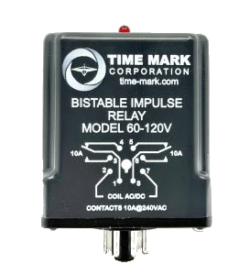
60-120V
Bistable Impulse Latching RelayRead moreThe Model 60 is a Bistable Impulse Latch Relay. When power pulse is applied, the Impulse LED on the top of the relay will illuminate and the relay will change state. Power can then be removed and the relay will remain in that state (mechanical latch). When power pulse is reapplied, the relay will change state and latch. -
60-240V
Bistable Impulse Latching RelayRead moreThe Model 60 is a Bistable Impulse Latch Relay. When power pulse is applied, the Impulse LED on the top of the relay will illuminate and the relay will change state. Power can then be removed and the relay will remain in that state (mechanical latch). When power pulse is reapplied, the relay will change state and latch. -
60-24V
Bistable Impulse Latching RelayRead moreThe Model 60 is a Bistable Impulse Latch Relay. When power pulse is applied, the Impulse LED on the top of the relay will illuminate and the relay will change state. Power can then be removed and the relay will remain in that state (mechanical latch). When power pulse is reapplied, the relay will change state and latch.