
Engineered and Built in the USA
(800) 862-2875

3-Phase-Monitors
Showing 65–80 of 213 resultsSorted by latest
-
A2594
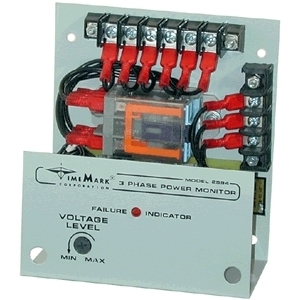
The Model 2594 3-Phase Monitor is designed for use with applications which require high control voltage (up to 600VAC). The Model 2594 protects 3-phase equipment and motors from phase loss, phase reversal and low voltage. When the correct voltage and phase rotation is applied, an internal DPDT relay energizes.A fault condition drops out the relay and the FAILURE INDICATOR LED illuminates. When the existing fault is corrected the unit will automatically reset. The Model 2594 can detect a phase loss condition even when regenerative voltage is present. It may be used with Wye or Delta systems; no neutral connection is required.
Standard operating ranges are available from 120 to 575 VAC, 60Hz, and 380VAC, 50Hz.
-
2581-480
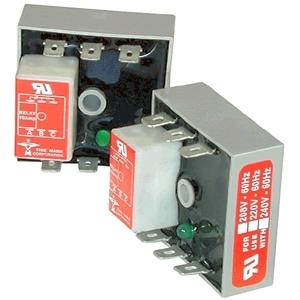
The Model 2581 3-Phase Monitor is designed to continuously monitor 3-phase power lines for phase loss, low voltage and phase reversal. The Model 2581 Monitor will detect phase loss on a loaded motor even when regenerated voltage is present.This device consists of a solid-state voltage and phase-angle sensing circuit, driving an electromechanical relay. When correct voltage and phase rotation are applied, the internal relay will energize. A fault condition will de-energize the relay. When the fault is corrected, the monitor will automatically reset .
The Model 2581 3-Phase Monitor does not require a neutral connection and can be used with Wye or Delta configured systems. Low voltage trip point is factory set at 10% below nominal. An LED indicator is provided for system troubleshooting.
-
2581-240
The Model 2581 3-Phase Monitor is designed to continuously monitor 3-phase power lines for phase loss, low voltage and phase reversal. The Model 2581 Monitor will detect phase loss on a loaded motor even when regenerated voltage is present.This device consists of a solid-state voltage and phase-angle sensing circuit, driving an electromechanical relay. When correct voltage and phase rotation are applied, the internal relay will energize. A fault condition will de-energize the relay. When the fault is corrected, the monitor will automatically reset .
The Model 2581 3-Phase Monitor does not require a neutral connection and can be used with Wye or Delta configured systems. Low voltage trip point is factory set at 10% below nominal. An LED indicator is provided for system troubleshooting.
-
2581-220
The Model 2581 3-Phase Monitor is designed to continuously monitor 3-phase power lines for phase loss, low voltage and phase reversal. The Model 2581 Monitor will detect phase loss on a loaded motor even when regenerated voltage is present.This device consists of a solid-state voltage and phase-angle sensing circuit, driving an electromechanical relay. When correct voltage and phase rotation are applied, the internal relay will energize. A fault condition will de-energize the relay. When the fault is corrected, the monitor will automatically reset .
The Model 2581 3-Phase Monitor does not require a neutral connection and can be used with Wye or Delta configured systems. Low voltage trip point is factory set at 10% below nominal. An LED indicator is provided for system troubleshooting.
-
2581-208
The Model 2581 3-Phase Monitor is designed to continuously monitor 3-phase power lines for phase loss, low voltage and phase reversal. The Model 2581 Monitor will detect phase loss on a loaded motor even when regenerated voltage is present.This device consists of a solid-state voltage and phase-angle sensing circuit, driving an electromechanical relay. When correct voltage and phase rotation are applied, the internal relay will energize. A fault condition will de-energize the relay. When the fault is corrected, the monitor will automatically reset .
The Model 2581 3-Phase Monitor does not require a neutral connection and can be used with Wye or Delta configured systems. Low voltage trip point is factory set at 10% below nominal. An LED indicator is provided for system troubleshooting.
-
2532
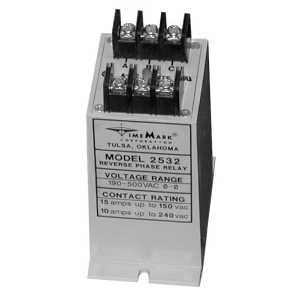
The Model 2532 Reverse Phase Relay is designed to continuously monitor phase rotation of 3-phase lines. This device should be used in applications where proper phase rotation is critical, such as fan motors, compressors, grinders, elevators, etc.The solid-state sensing circuit drives an internal electromechanical relay which energizes when power, with correct phase rotation, is applied.
The relay will not energize if the applied phases are reversed. It will de-energize if phase rotation is reversed while the motor is running. An LED indicator will illuminate with correct ABC phase rotation.Features:
- Senses phase reversal on Wye or Delta
- 190 to 500 VAC range
- Machine tool case
- UL Recognized & CSA Certified
-
2501D-600
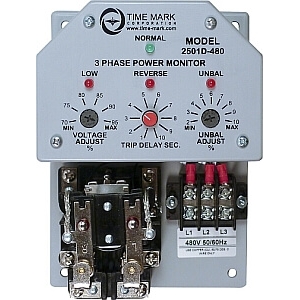
The Model 2501D 3-Phase Monitors are designed to continuously monitor the voltages of a 3-phase power distribution system for abnormal conditions. The monitors feature solid-state voltage and phase angle sensing circuits which drive a DPDT electromechanical output relay. Connect to any 3-phase WYE or DELTA with no neutral connection required.When the correct voltage and phase sequence is applied, the output relay will energize. An under voltage, phase reversal, phase unbalance, or phase loss condition will cause the output relay to de-energize.
-
2501D-480
The Model 2501D 3-Phase Monitors are designed to continuously monitor the voltages of a 3-phase power distribution system for abnormal conditions. The monitors feature solid-state voltage and phase angle sensing circuits which drive a DPDT electromechanical output relay. Connect to any 3-phase WYE or DELTA with no neutral connection required.When the correct voltage and phase sequence is applied, the output relay will energize. An under voltage, phase reversal, phase unbalance, or phase loss condition will cause the output relay to de-energize.
-
2501D-415
The Model 2501D 3-Phase Monitors are designed to continuously monitor the voltages of a 3-phase power distribution system for abnormal conditions. The monitors feature solid-state voltage and phase angle sensing circuits which drive a DPDT electromechanical output relay. Connect to any 3-phase WYE or DELTA with no neutral connection required.When the correct voltage and phase sequence is applied, the output relay will energize. An under voltage, phase reversal, phase unbalance, or phase loss condition will cause the output relay to de-energize.
-
2501D-380
The Model 2501D 3-Phase Monitors are designed to continuously monitor the voltages of a 3-phase power distribution system for abnormal conditions. The monitors feature solid-state voltage and phase angle sensing circuits which drive a DPDT electromechanical output relay. Connect to any 3-phase WYE or DELTA with no neutral connection required.When the correct voltage and phase sequence is applied, the output relay will energize. An under voltage, phase reversal, phase unbalance, or phase loss condition will cause the output relay to de-energize.
-
2501D-240
The Model 2501D 3-Phase Monitors are designed to continuously monitor the voltages of a 3-phase power distribution system for abnormal conditions. The monitors feature solid-state voltage and phase angle sensing circuits which drive a DPDT electromechanical output relay. Connect to any 3-phase WYE or DELTA with no neutral connection required.When the correct voltage and phase sequence is applied, the output relay will energize. An under voltage, phase reversal, phase unbalance, or phase loss condition will cause the output relay to de-energize.
-
2501D-208
The Model 2501D 3-Phase Monitors are designed to continuously monitor the voltages of a 3-phase power distribution system for abnormal conditions. The monitors feature solid-state voltage and phase angle sensing circuits which drive a DPDT electromechanical output relay. Connect to any 3-phase WYE or DELTA with no neutral connection required.When the correct voltage and phase sequence is applied, the output relay will energize. An under voltage, phase reversal, phase unbalance, or phase loss condition will cause the output relay to de-energize.
-
2501D-120
The Model 2501D 3-Phase Monitors are designed to continuously monitor the voltages of a 3-phase power distribution system for abnormal conditions. The monitors feature solid-state voltage and phase angle sensing circuits which drive a DPDT electromechanical output relay. Connect to any 3-phase WYE or DELTA with no neutral connection required.When the correct voltage and phase sequence is applied, the output relay will energize. An under voltage, phase reversal, phase unbalance, or phase loss condition will cause the output relay to de-energize.
-
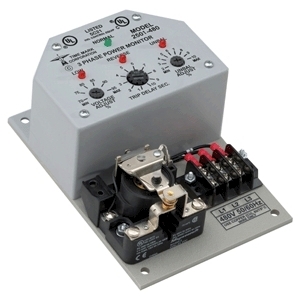
2501-600
The Model 2501 3-Phase Monitor is designed to continuously monitor 3-phase power lines for abnormal conditions. This device features solid-state voltage and phase-angle sensing circuits, which drive a SPDT electromechanical output relay.When the correct voltage and phase sequence is applied to a specified Model 2501, the output relay will energize. An under voltage, phase reversal, phase unbalance, or phase loss condition will cause the output relay to de-energize. A neutral connection is not required, allowing the Model 2500 or 2501 to be used with either Wye or Delta system configurations.
Each option on the Model 2500 or 2501 monitor is adjustable throughout its operating range. The adjustment pots and LED indicators for VOLTAGE ADJUST, UNBALANCE ADJUST and TIME DELAY are mounted on the front of the unit for easy access.
Seven versions of the Model 2500 or 2501 cover voltage ranges from 120 to 600 VAC, and are UL Listed and CSA Certified.
-
2501-480
The Model 2501 3-Phase Monitor is designed to continuously monitor 3-phase power lines for abnormal conditions. This device features solid-state voltage and phase-angle sensing circuits, which drive a SPDT electromechanical output relay.When the correct voltage and phase sequence is applied to a specified Model 2501, the output relay will energize. An under voltage, phase reversal, phase unbalance, or phase loss condition will cause the output relay to de-energize. A neutral connection is not required, allowing the Model 2500 or 2501 to be used with either Wye or Delta system configurations.
Each option on the Model 2500 or 2501 monitor is adjustable throughout its operating range. The adjustment pots and LED indicators for VOLTAGE ADJUST, UNBALANCE ADJUST and TIME DELAY are mounted on the front of the unit for easy access.
Seven versions of the Model 2500 or 2501 cover voltage ranges from 120 to 600 VAC, and are UL Listed and CSA Certified.
-
2501-415
The Model 2501 3-Phase Monitor is designed to continuously monitor 3-phase power lines for abnormal conditions. This device features solid-state voltage and phase-angle sensing circuits, which drive a SPDT electromechanical output relay.When the correct voltage and phase sequence is applied to a specified Model 2501, the output relay will energize. An under voltage, phase reversal, phase unbalance, or phase loss condition will cause the output relay to de-energize. A neutral connection is not required, allowing the Model 2500 or 2501 to be used with either Wye or Delta system configurations.
Each option on the Model 2500 or 2501 monitor is adjustable throughout its operating range. The adjustment pots and LED indicators for VOLTAGE ADJUST, UNBALANCE ADJUST and TIME DELAY are mounted on the front of the unit for easy access.
Seven versions of the Model 2500 or 2501 cover voltage ranges from 120 to 600 VAC, and are UL Listed and CSA Certified.